
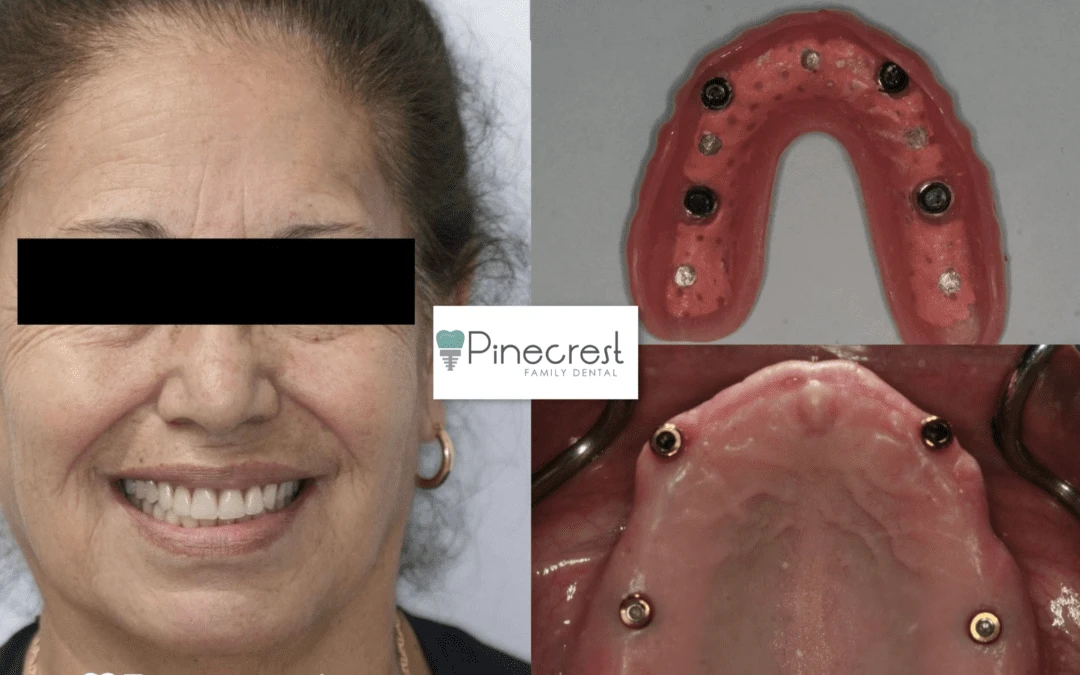
At Pinecrest Family Dental, many patients come to us after running into complications with previous dental treatment. In this case, Dr. Taidy Costoya treated a patient who was referred to our office to correct a problem involving a maxillary implant overdenture.
This case is a strong example of why proper planning matters in implant dentistry. When implant position does not support the final prosthesis, even well-intended treatment can create functional and restorative challenges.
Understanding the Problem
In this case, the patient’s front implants had been placed according to the anatomy of the maxilla. While that may sound appropriate at first, the implant angulation interfered with the path of insertion for the overdenture prosthesis.
That meant the restoration could not function as smoothly or predictably as intended. In implant dentistry, success is not only about placing implants. It is also about planning their position based on the final restoration.
Why Planning Matters in Implant Dentistry
At Pinecrest Family Dental, Dr. Taidy Costoya approaches implant cases with the end result in mind. The position, angle, and spacing of implants all affect how the final prosthesis will fit, function, and feel.
This is why treatment planning is so important from the start. As this case reminds us, failing to plan is planning to fail.
Why a Bar Overdenture Was Recommended
To address the implant angulation issue, a bar overdenture was advised because it would better correct the angulation, improve the path of insertion of the overdenture, and support the longevity of the implants. In cases like this, a bar-supported overdenture can provide a more favorable restorative design when implant positioning creates challenges.
It is also important to understand that not all overdentures function the same way. When implants are connected with a bar, they function more as a unit, which can improve load distribution and prosthetic stability. In a stud-type overdenture, each implant acts more independently, which may be less ideal in a case with angulation concerns.
A Practical Alternative
Although a bar overdenture was the ideal recommendation, the patient was not able to move forward with that option due to cost. In situations like this, our goal is always to find the most effective and practical solution possible for the patient.
The implant brand was especially important in this case. Dr. Costoya was fortunate that the implants already placed were Neodent implants, because that made it possible to work within a system that offered a practical restorative alternative.
How Dr. Costoya Solved the Case
Because the implants were Neodent, Dr. Costoya was able to use prefabricated angled locator abutments to help correct the implant angulation. Zest manufactures angled locator abutments for only a limited number of implant brands, including Neodent, ZimVie, Nobel Biocare, and BioHorizons.
These angled locator abutments helped correct the implant divergence, and extended-range insertion nylons provided additional correction to improve the path of insertion. Zest states that its angled abutment and extended-range system is designed to restore significantly angled implants by combining abutment correction with extended-range inserts.
Together, these components allowed us to create a functional overdenture solution without requiring the more expensive bar-supported restoration.
The Outcome
The patient was very happy with the final result. By carefully evaluating the limitations of the existing implant placement and choosing components that could compensate for the angulation, Dr. Costoya was able to restore function, improve fit, and deliver a successful outcome.
Cases like this reflect the importance of experience, problem-solving, and restorative planning in advanced dental care. Even when a case begins with complications, the right approach can still lead to an excellent result.
Why Patients Choose Pinecrest Family Dental
At Pinecrest Family Dental in Pinecrest, Florida, Dr. Taidy Costoya provides personalized care for patients with complex restorative and implant concerns. Whether a patient is starting treatment for the first time or needs help correcting a previous dental issue, our practice focuses on thoughtful planning, practical solutions, and high-quality results.
We understand that every patient’s needs, anatomy, and budget are different. That is why we take time to evaluate each case carefully and recommend treatment options that balance function, comfort, and long-term success.